Posts Tagged ‘webdev’
August 17th, 2010
With IE9 in development and Opera 10.5 released, CSS3 is a few steps away from being supported by all modern browsers. But users may take a while to upgrade, and responsible developers will support legacy browsers for years to come.
For some, cross-browser development means making websites that look exactly the same in all browsers. But if developers continue to cater websites to inadequate browsers such as IE6, then they’re just holding back modern browsers from performing to their potential.
Graceful degradation is not about allowing websites to look bad in older browsers, but about making them look great in modern ones. It means taking advantage of CSS3’s useful features to progressively enhance web pages for the vast majority of users.
Tags: browser hacks, cross-browser, CSS, css3, front-end, graceful degradation, IE, jQuery, web design, webdev
Posted in CSS | 14 Comments
July 29th, 2010
Yesterday’s CSS Summit featured some the best CSS minds presenting on cutting edge CSS issues. There was a ton of great information presented across the 8 sessions, but here’s a wrap up of the single best piece of information from each presenter:
Denise Jacobs – Advanced CSS Troubleshooting
The highlight of Denise’s talk was some specific coding tips about clearing floated content.
She started with the standard overflow: hidden method, which falls short with support for borders & margins and also doesn’t allow scrollbars if they’re needed. Denise suggested instead using overflow: auto; width: 100%; which avoids these issues. You don’t have to use the exact values above, you just have to set some type of overflow and width / height value.
Denise went on to discuss a .clearfix:after method, see the gist.
Denise likes this clearing method since it doesn’t include any extra, non-semantic markup (as … Read more…
Tags: best practices, conferences, cross-browser, CSS, css3, front-end, html5, web design, webdev
Posted in CSS | 1 Comment
March 30th, 2010
I’ve always been a fan of drawing page components with pure CSS rather than using image support. Although rendering the page with CSS can sometimes be a pain, the rewards of fewer HTTP requests & less download time make it well worthwhile.
Until recently, most web designers and developers couldn’t design using CSS alone, because there simply wasn’t enough cross-browser support for all the wonderful CSS3 attributes.
However, with IE9 just around the corner and Opera 10.5 already released, we are extremely close to the point where we can render web pages in CSS3 across all modern browsers (IE, Firefox, Chrome, Safari, Opera). Legacy browsers won’t get left out, since our CSS3 pages can degrade gracefully to square corners, flat-color backgrounds, etc. Additionally, we can use browser-specific stylesheets that include plain old image support for key design elements that shouldn’t degrade.
CSS3 makes drawing elements with CSS a … Read more…
Tags: best practices, cross-browser, CSS, css3, rendering, UI, web design, webdev
Posted in CSS | 14 Comments
February 10th, 2010
Nicholas Zakas is a Javascript guru and principle front-end engineer for the Yahoo! homepage. Zakas just announced his new book High Performance JavaScript, which you should order today.
Zakas is pretty much the man when it comes to Javascript performance, and in June he gave a Google Tech Talk entitled Speed Up Your Javascript.
While Javascript optimization is by no means black-and-white, here’s a list of 10 tips from Nicholas’ talk that will help you write Javascript that really flies.
1. Define local variables
When a variable is referenced, Javascript hunts it down by looping through the different members of the scope chain. This scope chain is the set of variables available within the current scope, and across all major browsers it has at least two items: a set of local variables and a set of global variables.
Simply put, the deeper the engine has to dig into this … Read more…
Tags: 10 tips, best practices, DOM, front-end, javascript, jQuery, loops, optimization, performance, scope, webdev
Posted in 10 Javascript Performance Tips, javascript | 21 Comments
December 22nd, 2009
In Javascript it often makes sense to attach a stylesheet rather than style a bunch of individual attributes. Appending a stylesheet to the DOM has a number of advantages:
-
Stylesheets can be easier to work with than Javascript—it’s just more natural to use CSS syntax for styling.
-
It’s nice to avoid the cross-browser headaches associated with Javascript styling. Compare CSS’s simple float: left to Javascript’s style.styleFloat = ‘left’ and style.cssFloat = ‘left’.
-
Appending a stylesheet is better for performance when styling 15 or more elements.
-
CSS allows you to leverage pseudo-classes and define styles with the simple a:hover selector instead of both onmouseover and onmouseout event listeners.
There are a couple ways to append a stylesheet. Although it’s usually best to attach an external stylesheet, there are times when you need to build a stylesheet on the fly with Javascript. Let’s walk through the code we’ll need to append … Read more…
Tags: append, best practices, cross-browser, CSS, DOM, front-end, javascript, on-the-fly, unobtrusive, web standards, webdev
Posted in front-end | 7 Comments
December 8th, 2009
TranslateThis is a new Javascript widget that provides 52 languages of translation by leveraging the Google Language API.
Installing TranslateThis couldn’t be easier—simply copy and paste the widget code anywhere on your website, you don’t have to upload any files or change any settings.
Besides being easy to use, TranslateThis also provides many attractive features for developers. First off, requests to the Language API run in Javascript, so the translation is pretty fast. Additionally, the script is lightweight, weighing in at just over 11kb with another 7kb of imagery. And since it doesn’t depend on any Javascript library, TranslateThis can be implemented on any website without additional overhead. Finally, TranslateThis has been tested in all modern browsers and its user interface is designed to be straightforward and seamless.
What can you customize in TranslateThis?
Tags: AJAX, analytics, cross-browser, customization, downloads, front-end, javascript, performance, plugins, translation, web design, webdev, widgets
Posted in front-end, webdev | 3 Comments
November 19th, 2009
There were a lot of good speakers at today’s jQuery Summit, but Paul Irish‘s talk on jQuery Anti-Patterns for Performance & Compression was my stand-out favorite. Covering a number of advanced jQuery performance optimization techniques, this speech put my knowledge of jQuery optimization to shame.
Before Paul’s talk my understanding of jQuery performance tuning was fairly simplistic:
- Optimize selectors to descend from an id if possible.
- Use tag names when selecting classes and don’t use an excessive number of selectors.
- Define variables instead of selecting the same object repeatedly.
- Optimize your code replacing repetition with object oriented functions.
But the information Paul presented blew all that out of the water. Here are 10 jQuery performance rules I gathered from his presentation:
1. Optimize selectors for Sizzle’s ‘right to left’ model
As of version 1.3, jQuery has been using the Sizzle Javascript Selector Library which works a bit differently from the … Read more…
Tags: front-end, javascript, jQuery, performance, selectors, webdev
Posted in webdev | 25 Comments
August 12th, 2009
My favorite thing about web development is the wide variety of skills it uses. Being a good developer means staying on your toes and always learning, because there are so many important skills and these are constantly changing.
Here’s a checklist of 10 skills that are some of the most important for good web developers to have. These focus a bit on front-end skills, but they apply to all developers:
(more…)
Tags: apache, back-end, best practices, checklists, cross-browser, cyber law, debugging, education, front-end, image processing, javascript, optimization, regex, SEO, version control, web standards, webdev
Posted in webdev | 18 Comments
July 13th, 2009
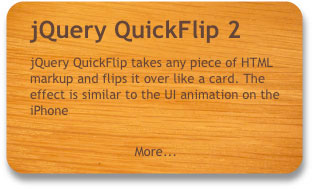
I’m happy to announce the release of QuickFlip 2, a major reworking of the jQuery plugin that flips any piece of HTML markup over like a card. The new version is faster and even easier to use—simply call the flip animation through a jQuery selector and the QuickFlip will flip the front panel to show its back. The flip effect is similar to the UI animation on the iPhone
Download QuickFlip 2 for jQuery
Read the QuickFlip documentation
QuickFlip works by using an animation shortcut that is barely noticeable when flipped quickly (hence the name). This shortcut improves performance while allowing the flip effect to work smoothly with any piece of markup regardless of images, backgrounds or CSS.
It provides an attractive alternative to other slower and more resource heavy Flash and jQuery flip animations. However if you want a smoother option with … Read more…
Tags: animation, front-end, javascript, jQuery, performance, plugins, UI, web design, web2.0, webdev
Posted in webdev | 144 Comments
June 2nd, 2009
Scrolling Parallax is a new jQuery plugin that binds a parallax effect to the scrollbars and mouse wheel. This allows a background image or anything else to scroll at a different pace than the web page when a user scrolls around. The parallax effect that results is an easy way to create an illusion of depth on your website.
Basic use of the Scrolling Parallax plugin is extremely easy. Simply pass the path to an image, and the plugin takes the image and stretches it to the window width and 150% of the height. The extra 50% of the height is scrolled down along with the document, smoothly reaching the end at the same time as the page.
The Scrolling Parallax plugin is also very versatile. There are a wide variety of options including scrolling faster, slower, looping and reversing the animation and tiling the … Read more…
Tags: animation, downloads, front-end, javascript, jQuery, open source, parallax, performance, plugins, web design, webdev
Posted in webdev | 81 Comments